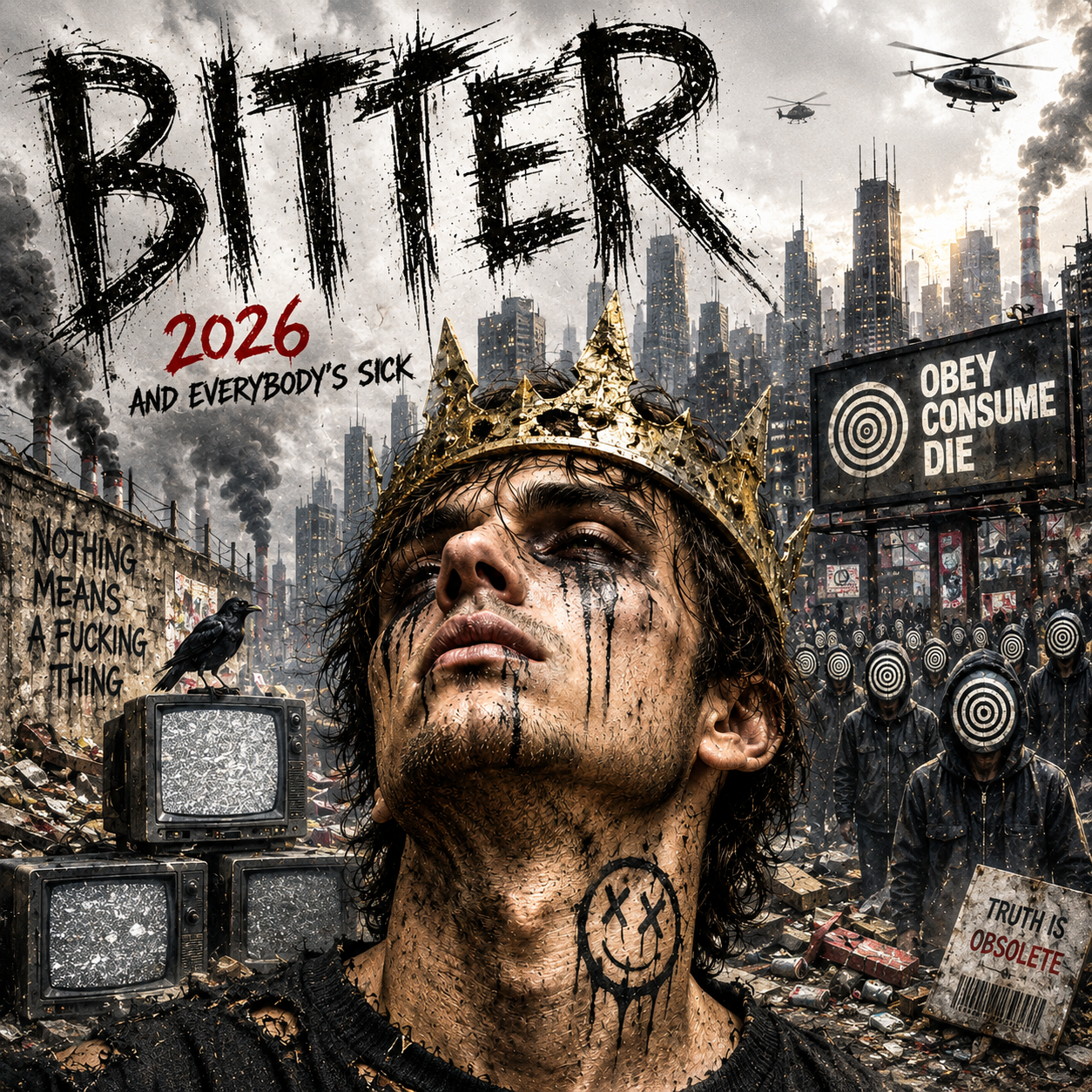
BITTER
BITTER — LYRICS
Static on the TV screen
Another dead American dream
Swipe left, scroll down, obey the feed
Everybody’s starving while the rich all feed
Yeah…
We’re all sick now
Plastic saints in a shopping mall
Digital gods watching us crawl
Everybody screaming to be seen
Nobody knows what the hell they mean
Prescription smiles and dopamine hits
Children raised by apocalypse scripts
Poison dripping from a polished lie
Another overdose beneath the sky
And I can feel it
Rotting underneath
Civilization grinding down its teeth
Bitter!
Everything tastes bitter now
Ashes falling from the sacred cow
Bitter!
Nothing means a fucking thing
Broken angels trying not to scream
We built this cage
Then swallowed the key
Welcome to humanity
2026
And everybody’s sick
Politicians dancing on a screen
Selling fear like gasoline
Every side says they’re the cure
While they poison something pure
Concrete oceans, neon graves
Algorithms making slaves
Lonely people packed in crowds
Heads held low, eyes in clouds
Mother nature’s coughing black
But nobody’s turning back
Everybody wants to save the earth
As long as profits come first
And I can hear it
Under every breath
A generation choking itself to death
Bitter!
Everything tastes bitter now
Ashes falling from the sacred cow
Bitter!
Nothing means a fucking thing
Broken angels trying not to scream
We built this cage
Then swallowed the key
Welcome to humanity
2026
And everybody’s sick
I don’t need another prophet
Another brand-new war
Another hollow influencer
Selling emptiness for more
I don’t want your false salvation
Or synthetic paradise
Everybody’s getting famous
While they slowly die inside
Dead feeds
Dead streets
Dead eyes staring back at me
No love
No truth
No god coming to rescue you
Bitter!
Everything tastes bitter now
Ashes falling from the sacred cow
Bitter!
Nothing means a fucking thing
Broken angels trying not to scream
We built this cage
Then swallowed the key
Welcome to humanity
2026…
And everybody’s sick
Static on the TV screen…
Another dead American dream…